Foley
A sound library catalog and MCP server, so Claude Code can search audio it cannot hear.
- Status
- Open source
- License
- MIT
- Platform
- Windows · Linux · macOS
- Built with
- Python · MCP
Overview
Foley indexes a sound library so that Claude Code, which cannot hear, can search it, inspect it and pick audio from it.
Point it at a folder or network share of sound effects and music. Foley analyzes every file once, offline, and keeps that analysis in sync as the library changes: words from file names, folders and embedded metadata, AudioSet tags, CLAP audio embeddings, loudness and the rest of the technical picture, and a waveform and spectrogram image for every sound.
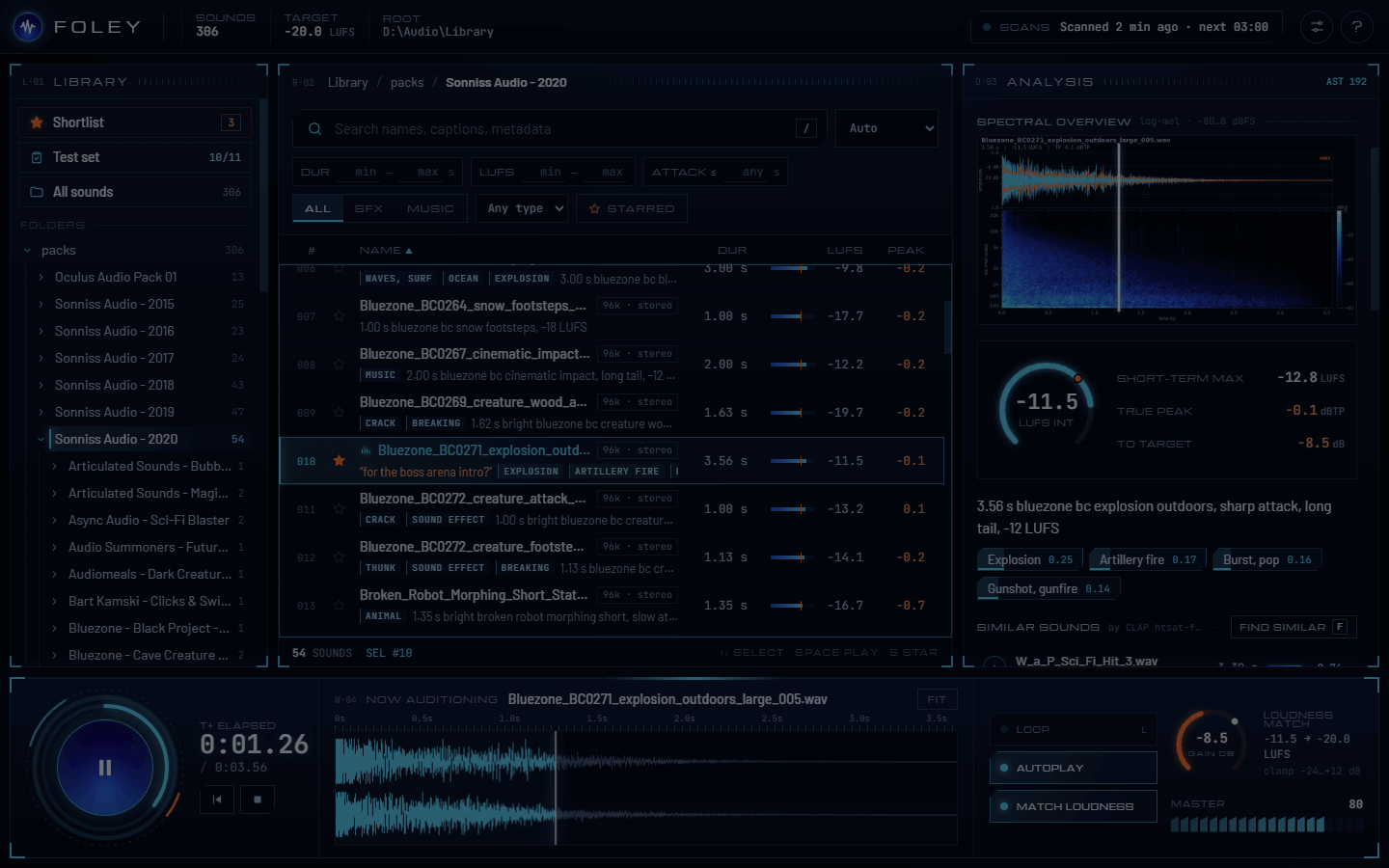
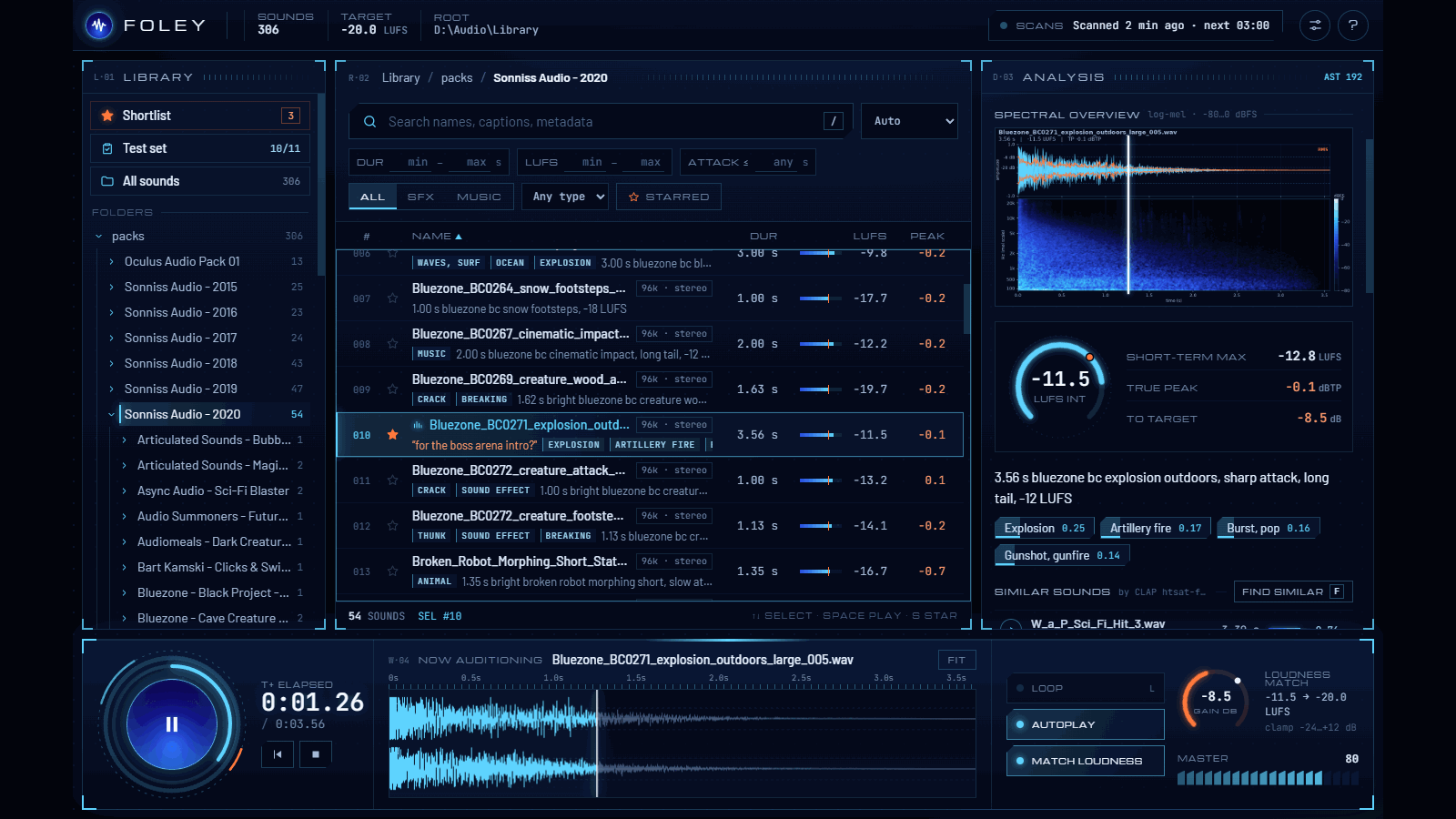
Claude Code reaches the catalog through an MCP server. It searches by description, reads spectrograms side by side to compare candidates, and imports the winner into the game project at the right loudness. People get foley browse, a fast local browser for auditioning the same library, and the sounds they star there reach Claude as a shortlist.
An internal Soverance Studios tool, shared as-is under the MIT license. No support commitment, no release cadence.
Screenshots
Features
Search by Sound
Hybrid search blends keyword matching over names, folders, metadata and tags with CLAP similarity between your words and the audio itself, so a file can be found by how it sounds even when its name says nothing.
Eyes for Claude
Claude Code cannot hear, so Foley draws for it: waveforms and spectrograms at identical scales, side by side, to compare by attack, tail and brightness. The winner goes into the game project at the loudness its slot calls for.
foley browse
A local browser for people: audition with loudness matching, see the full analysis while you listen, and star sounds onto a shortlist that Claude Code picks up.
Read-Only, Always in Sync
Incremental, resumable indexing follows files as they are added, moved and removed, and a daily scan keeps the catalog current. Nothing ever writes to the library, and a test enforces it.